STEAM, FOAM, POUR
Café milk drinks succeed or fail on emulsion physics. When milk is heated to 60°C–65°C, lactose sugars taste sweetest and whey proteins unfold to encase microscopic air bubbles. Above 70°C, proteins denature permanently, producing sulfuric off-flavors and stiff foam that refuses to pour.
THE FRENCH PRESS MICROFOAM TECHNIQUE
Target Temp62°C–65°C
Air In3 Plunges
Shear25 Pumps
TextureWet Paint
No battery frother can match the shearing power of a stainless steel mesh plunger. This procedure matches commercial steam wand microfoam for latte art.
Equipment & Reagents
- 200ml cold whole cow's milk (minimum 3.5% fat) or Oatly Barista Edition
- Clean 350ml or 500ml French press beaker with tight-fitting plunger
- Small saucepan or microwave-safe jug + digital kitchen thermometer
- Milk pouring pitcher with narrow spout
Step-by-Step Procedure
- Thermal heating: Gently warm 200ml milk on low heat to exactly 63°C. Remove immediately from heat. Pre-heat your French press beaker with hot tap water and empty it.
- Pour warm milk: Pour the hot milk into the warm French press carafe (it should fill roughly one-third of the glass).
- Aeration (Stretching): Insert the plunger. Make 3 large, full-length strokes pulling all the way to the top of the milk to incorporate atmospheric air.
- Emulsification (Texturing): Keep the mesh completely submerged below the milk surface. Rapidly pump up and down 25 to 30 times in short, fast 1-inch strokes. This shears large bubbles into sub-millimeter microfoam.
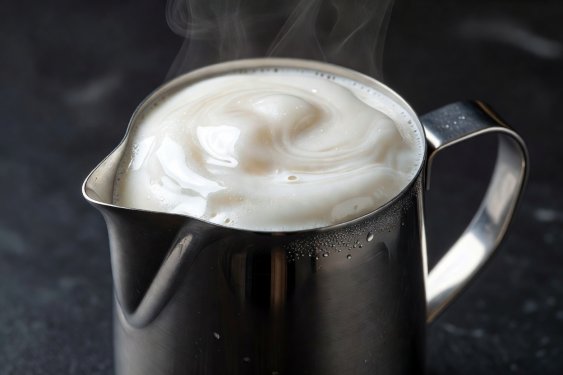
- Transfer and polish: Pour immediately into a metal pouring pitcher. Swirl the pitcher on the counter and tap firmly once to pop any remaining stray bubbles. The surface will look like glossy white gloss paint.

PLANT-BASED EMULSION SCIENCE
Oat Max58°C
Soy Max60°C
AlmondLow Fat
BufferDipotassium
Plant milks react unpredictably when added to acidic coffee. Without animal proteins, they curdle if temperature or acidity spikes.
Critical Rules for Oat & Soy
- Pick "Barista" formulations: Regular grocery oat milk contains 1% fat. Barista variants incorporate sunflower or rapeseed oil and dipotassium phosphate (an acidity buffer that prevents curdling).
- Cap temperature at 58°C: Plant starches gel above 60°C, transforming smooth milk into gummy pudding. Keep it noticeably cooler than dairy milk.
- Equalize temperatures: Do not pour fridge-cold plant milk into boiling coffee concentrate, nor boiling milk into cold espresso. Temper them progressively.
Drink Architecture Formulas
| Drink Style | Coffee Base | Milk Volume | Foam Depth |
|---|---|---|---|
| Flat White | 60ml moka pot shot | 120ml microfoam | 5mm microfoam head |
| Cortado | 40ml moka pot shot | 40ml warm milk | Little to no foam layer |
| Café Latte | 60ml moka pot shot | 200ml microfoam | 10mm microfoam head |
Elevate your milk drink with subtle bespoke sweeteners and whole botanical extractions.
EXPLORE COFFEE FLAVOURS